
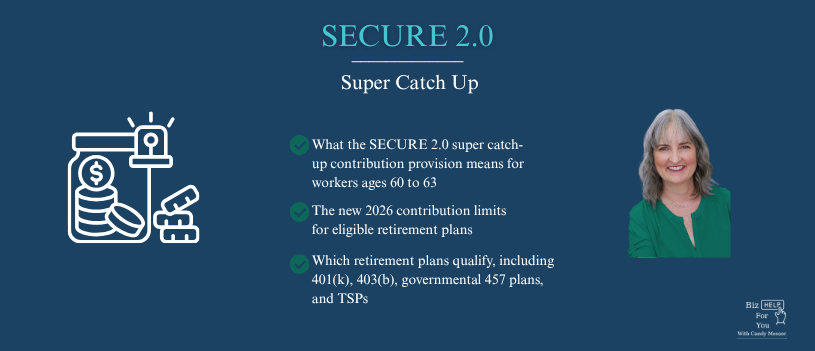
SECURE 2.0 catch-up contributions give eligible workers ages 60 through 63 a valuable opportunity to increase retirement savings during some of their highest earning years.
Under SECURE 2.0, employees participating in certain employer-sponsored retirement plans can make enhanced catch-up contributions beyond the standard age-50 catch-up amount. For 2026, the regular employee deferral limit is $24,500. Most workers age 50 and older can contribute an additional $8,000 as a catch-up contribution, bringing their total contribution limit to $32,500.
However, individuals ages 60, 61, 62, and 63 may qualify for enhanced catch-up contributions of up to $11,250. This increases their total potential contribution to $35,750 for 2026.
These higher contribution limits apply to qualified plans such as 401(k), 403(b), governmental 457(b), and federal Thrift Savings Plans. They do not apply to Individual Retirement Accounts (IRAs), which have separate contribution limits.
Business owners should also understand that retirement plans must allow the enhanced catch-up provision before employees can take advantage of it. Reviewing plan documents with a retirement plan administrator can help ensure compliance and maximize available benefits.
Higher-income employees should pay close attention to the Roth catch-up requirement. Individuals who earned more than $150,000 from their employer during the previous year generally must make catch-up contributions as Roth contributions, meaning they are made with after-tax dollars.
SECURE 2.0 catch-up contributions create an important retirement planning opportunity for both employees and employers. Reviewing contribution limits, plan provisions, and Roth requirements now can help prevent missed savings opportunities later.
Key Notes:
- Workers ages 60 through 63 may qualify for enhanced retirement plan catch-up contributions under SECURE 2.0.
- For 2026, eligible individuals can contribute up to $35,750 to certain employer-sponsored retirement plans.
- The enhanced catch-up amount is $11,250, compared to the standard catch-up contribution of $8,000 for workers age 50 and older.
- These higher limits apply to 401(k), 403(b), governmental 457(b), and Thrift Savings Plans, but not IRAs.
- Employers must adopt the enhanced catch-up provision in their retirement plans before employees can take advantage of it.
- Higher-income employees who earned more than $150,000 from the same employer in the previous year may be required to make catch-up contributions as Roth contributions.