
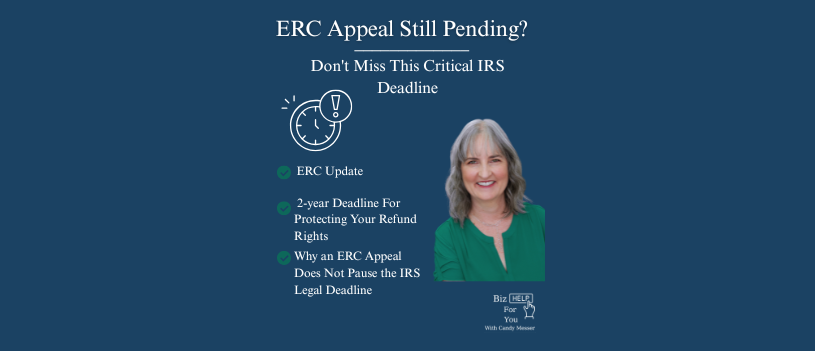
The ERC appeal deadline could determine whether your business receives an Employee Retention Credit refund. Many business owners believe that filing an appeal pauses every IRS deadline. Unfortunately, that is not true. While the IRS reviews your appeal, the legal deadline continues to count down. If you miss it, you could lose your right to receive a refund.
The Employee Retention Credit, or ERC, helped many businesses recover from the financial challenges of recent years. However, the IRS has closely reviewed many claims. As a result, thousands of business owners have faced delays, denials, and lengthy appeals.
If the IRS denied your claim, you likely received Letter 105-C or Letter 106-C. Letter 105-C fully disallows an ERC claim. Letter 106-C partially disallows it. Many taxpayers choose to appeal these decisions through the IRS Independent Office of Appeals.
Filing an appeal does not stop the ERC appeal deadline. In most cases, you have two years from the date on your disallowance letter to protect your legal rights. During that time, you must either complete the IRS administrative process or file a refund lawsuit in federal court. Once the deadline passes, the IRS generally cannot issue your refund, even if it later agrees that your claim was valid.
The IRS recently announced a new option for taxpayers with pending ERC appeals. Eligible businesses can request more time by submitting Form 907, Agreement to Extend the Time to Bring Suit. If the IRS approves the request, both sides receive additional time. The IRS gains more time to review the appeal, and you gain more time to file a refund lawsuit if necessary.
You may qualify for this extension if you meet two requirements. First, the IRS must still be reviewing your response to Letter 105-C or Letter 106-C. Second, you must have six months or less remaining before your two-year deadline expires.
The IRS also allows eligible taxpayers to submit Form 907 electronically through its Document Upload Tool. Some taxpayers will receive Notice CP320B that explains this process. However, you may still qualify even if you never receive that notice.
One important detail often surprises business owners. Every ERC appeal deadline is different. Your deadline depends on the date printed on your original disallowance letter. It does not depend on when you filed your appeal or how long the IRS has taken to respond.
If your Employee Retention Credit appeal remains pending, take a few minutes to review your paperwork. Find your disallowance letter and calculate your deadline. Then speak with your tax professional about whether Form 907 makes sense for your situation.
Waiting too long could cost you your refund. A simple review of your ERC appeal deadline today may help protect your right to receive the money your business may still be owed.

Key Notes
- Filing an ERC appeal does not stop the legal two-year deadline to protect your refund rights.
- ERC claim denials are typically issued through Letter 105-C or Letter 106-C.
- Taxpayers generally have two years from the disallowance letter date to resolve the claim or file a refund lawsuit.
- Missing the deadline may permanently prevent the IRS from issuing a refund.
- The IRS has introduced a streamlined process for eligible taxpayers to request additional time.
- Eligible taxpayers may submit Form 907, Agreement to Extend the Time to Bring Suit.
- Form 907 can now be submitted electronically through the IRS Document Upload Tool.
- You may qualify if your appeal is still pending and you have six months or less before your deadline expires.
- Some taxpayers will receive Notice CP320B, but receiving it is not required for eligibility.
- Every ERC deadline is unique because it is based on the date of the original disallowance letter.
- Business owners should review their deadline promptly and consult a tax professional if an extension may be needed.